On Sunday evening, August 17, a room at the Retreat Sportsman’s Club near De Soto filled for a town hall on the proposed 765 kV transmission lines — the largest ever proposed in Wisconsin. For roughly ninety minutes, the people most affected put their questions directly to the people who represent them, and got answers on the record.
The event was organized by the Coalition Against Maribel 765 and sponsored by No 765 Line, Inc. and No AI Power, Inc. Moderator Erik Olsen, an eminent domain attorney, put questions written by the coalition’s own members to a five-official panel: State Senator Brad Pfaff, State Representatives Tara Johnson and Travis Tranel, U.S. Representative Derrick Van Orden, and Viroqua Mayor Krista Browne, joined by Dr. David D. King, an independent write-in candidate for governor. Each panelist got two minutes per question.
The questions were not abstractions. They came from people who have received right-of-way letters: What have you done about the MariBell project? Would you strengthen protections against eminent domainThe government’s power to take private property for a public use, with compensation. Wisconsin law extends a version of this power to utilities for approved transmission projects. when a taking mostly serves private profit? How close to a 765 kV line would you let your own family live? Should ultra-high-voltage lines be buried in existing public rights-of-way even if that costs more? Do we need the data centers at all?
Source · Event recording, Coalition Against Maribel 765 town hall, De Soto, Wis., Aug. 17, 2026 (full video)
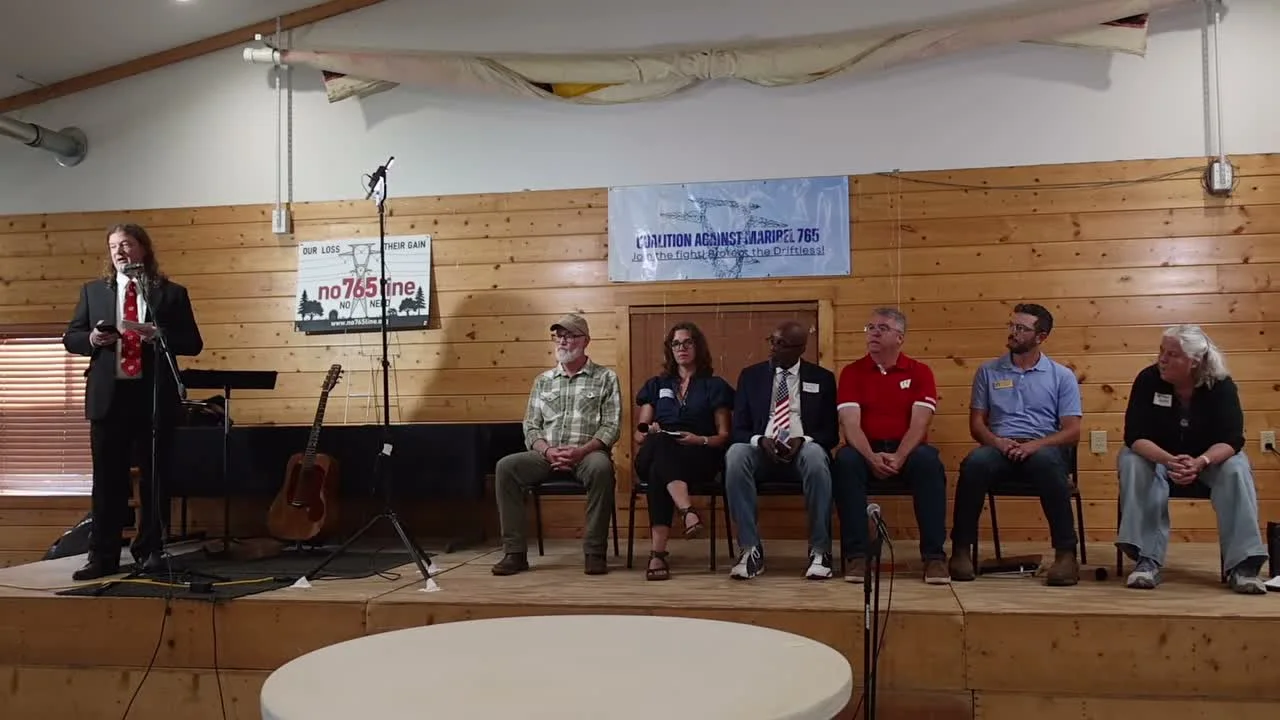
Don’t take our word for any of it. The Coalition Against Maribel 765 posted the complete, unedited video — every answer in this article, in context, from a room full of your neighbors. Watch it on their channel, and share it with someone who couldn’t be there — every view helps the coalition reach more landowners.
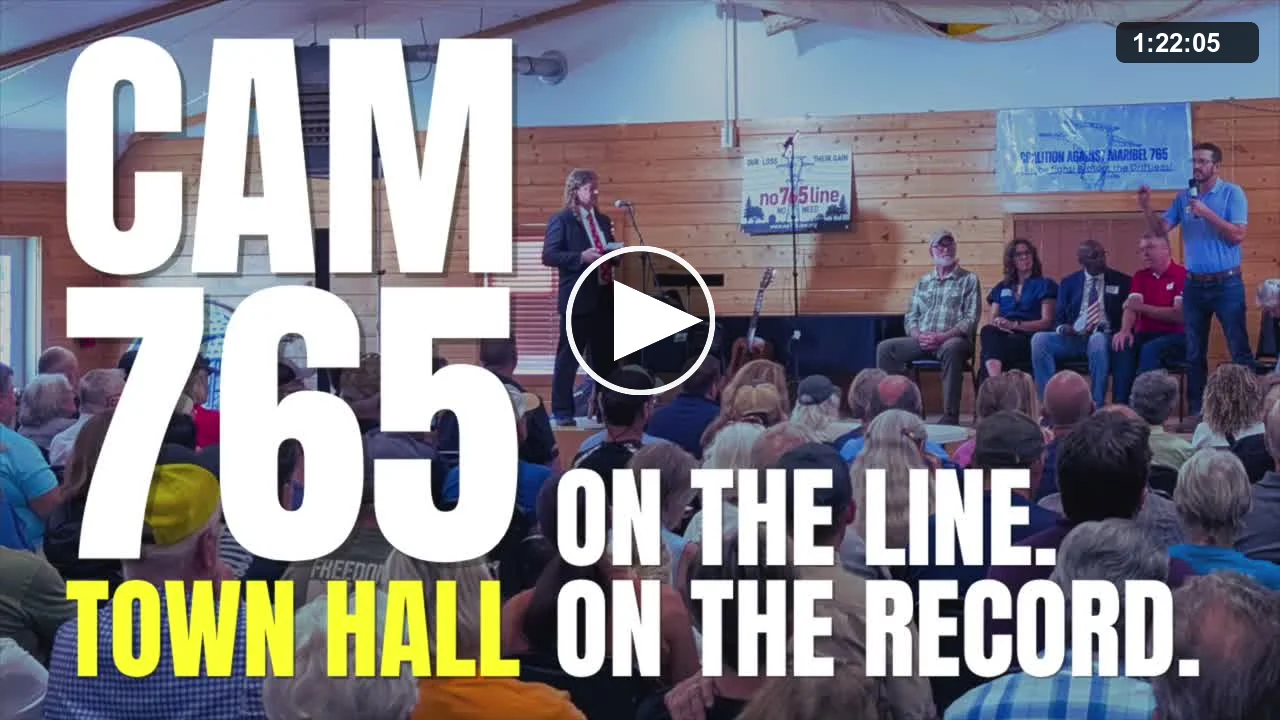 Video · Coalition Against Maribel 765
Where the panel stood
Mayor Krista Browne: “There is no far enough away”
Viroqua’s newly elected mayor told the room her father in Hill Point received a landowner letter a week ago, and described losing a previous home in Iowa County after a cell tower went up next door without a permit. “I believe that the power of people is greater than the power of money,” she said. Asked how close she would live to a 765 kV line, she gave the night’s flattest answer:
“There is no far enough away when it’s this much power.”
She returned repeatedly to true cost accounting, including what the region’s karstLandscape formed where water dissolves the underlying bedrock, leaving caves, sinkholes, springs, and fast paths between the surface and groundwater. Much of the Driftless sits on karst, which is why construction near it raises water questions. geology means for construction at this scale: “When that pylon at 10 feet by 80 feet under those towers hits a cave that gets filled, what happens to our aquifers? We’re standing on four aquifers right here.”
Dr. David D. King: “If you don’t want it, you should not have to have it”
King, an independent write-in candidate for governor, drove from Milwaukee and framed the fight as a matter of consent: “I wouldn’t want my enemy living that close. … If you don’t want it, you should not have to have it. Point blank and simple.” On data centers, he argued disclosure has to come before construction: “If they keep the information from us, we’re ignorant to the information, and they get to govern us.”
Sen. Brad Pfaff: “Bury the wire”
Pfaff pointed to the transmission-siting bill he authored with Rep. Johnson: route new lines along existing utility and highway rights-of-way, and underground them in fragile landscapes.
“Follow existing utility infrastructure right-of-way. That’s number one. … When it comes to fragile and unique landscapes like we have, bury the wire. They’re gonna tell you they can’t afford it, but make them tell you that, because I’ll tell you, when it comes to broadband we’re burying the fiber.”
He also raised distributed generation — the Driftless-grown alternative to moving bulk power hundreds of miles — and pressed a point about the regulator itself: of the three Public Service Commissioners, only one has been confirmed by the state Senate, and the next governor will make the next appointments. “I guarantee you, I will be having conversations with those appointees,” he said.
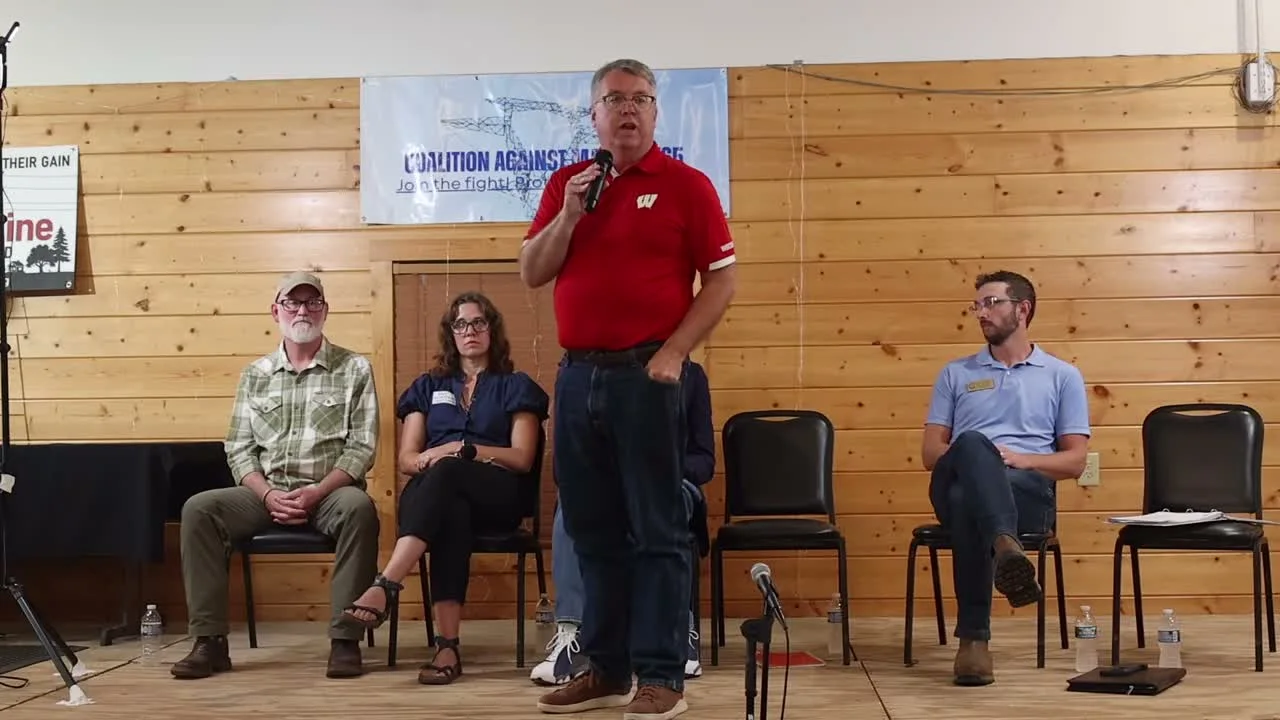
Rep. Travis Tranel: “We are permanently altering the landscape of rural Wisconsin”
Tranel, a Cuba City dairy farmer with 16 years on the Assembly’s energy committee, gave the room a crash course in how utility economics drive transmission: the roughly 10 percent return utilities earn on approved projects, the 2009 law that removed local control over siting large wind projects, and the “right of first refusal” bills that would have let incumbent utilities build MISO-ordered lines with no competitive bid (“I fought like hell to kill that for two or three sessions in a row”). His prescription, repeated all night: generate baseload power closer to where it is used. He did not spare either party — “the utilities are so powerful, they have both parties in their pocket.”
“We are permanently altering the landscape of rural Wisconsin, and we are not getting anything for it.”
Rep. Tara Johnson: “We continued to say no”
Johnson, whose 96th Assembly District covers much of the affected area, said the transmission projects are the single biggest topic in her district office hours. Asked how she weighs a project like this, she answered with a story from her time chairing the La Crosse County Board, when the state ordered the county to approve a cell tower on fragile land in the Town of Holland.
“The state told us we had to site the tower. We said no. And we were threatened with lawsuits, and we continued to say no. And the company found another location for that cell tower.”
Her yardstick: “The common good above the individual profit-making good.”
Rep. Derrick Van Orden: “Put small modular units back in Genoa”
Van Orden, who lives nearby and attended with his wife, staked out the night’s clearest position on where power should come from instead of a 765 kV import line: more baseload generation — “nuclear energy, clean-burning coal energy, and clean-burning natural gas” — built close to where it is used. And he went further than any panelist on a specific site: the retired Genoa nuclear plant, whose reactor ran on the Mississippi shoreline from 1969 to 1987.
“I think I found a couple billion dollars between the Department of Energy and the Department of Agriculture to put small modular units back in Genoa where they were before, which will cut a huge amount of this problem out. … There’s already storage there. There’s already transmission lines there. Everything’s already there. So if we can get that project going, then a lot of these things are going to be eliminated.”
His argument, in short: generate at Genoa again and the case for a 765 kV import line shrinks. He said his office has been working on the funding “for about nine months.” He paired it with a proposal to put data centers on federal military land such as Fort McCoy rather than farmland (“You cannot cover up our black dirt”), and he was blunt on the eminent domain question, telling the room it would never be okay with him to take private property so a single company can profit. What the public record shows about Genoa — including who owns the site — is in the official record below.
Source · Event recording, Aug. 17, 2026
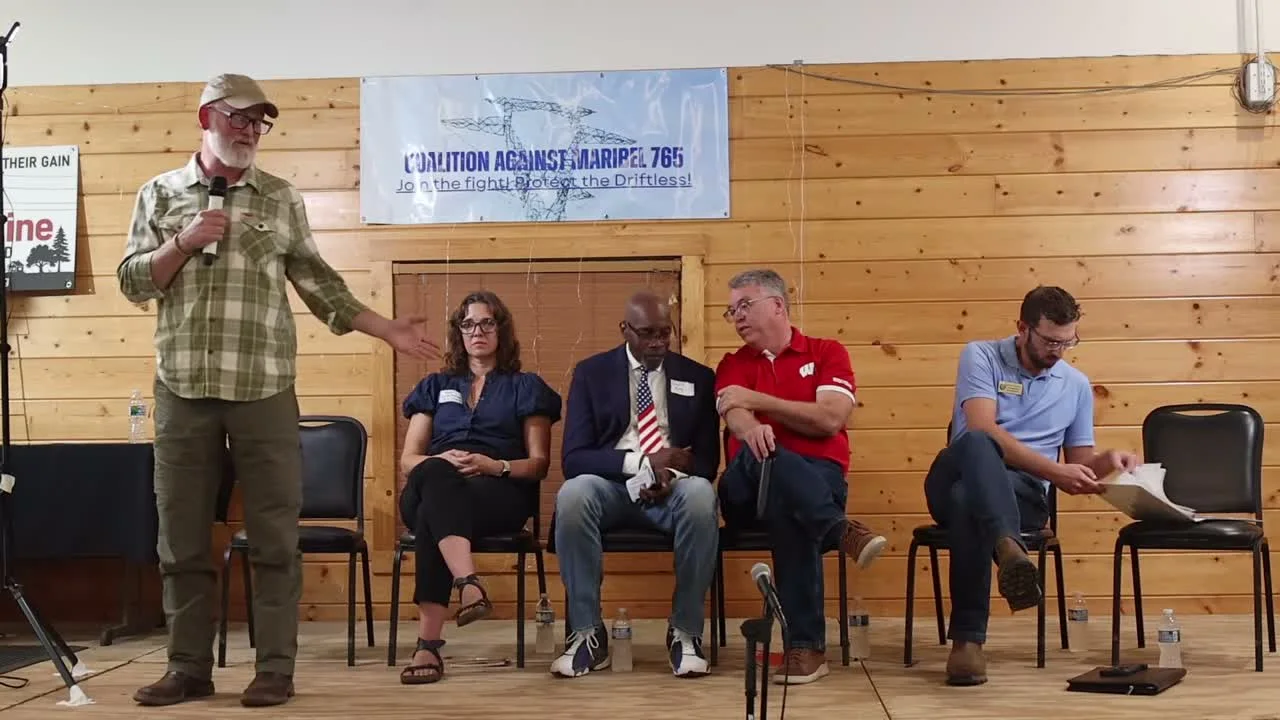
After the panel: the organizers
Jay McCloskey, chair of No 765 Line, Inc., recounted how the campaign began: in late October, Dairyland Power right-of-way agents started knocking on doors in Crawford and Vernon counties offering $500 for survey consent agreements granting, in the document’s own words, “an irrevocable license and right of entry … to conduct survey work, including soil borings,” with entry allowed without prior notice for two years. Landowners organized within days.
Rob Danielson turned to the BECI project’s compressed clock. Roughly 1,000 landowners received letters about ten days earlier telling them their property sits in a study segment, and the developer intends to reach a filed application in a fraction of the time earlier Wisconsin lines took:
“American Transmission Company, for Cardinal-Hickory Creek and for Badger-Coulee, spent 37 to 43 months informing us, receiving our input. … If they were to start offering meetings with the landowners tomorrow, only a fraction of them could even meet with them one time before the applicant would have its final plan submitted to the Public Service Commission.”
Tim Woodhouse, who leads the Coalition Against Maribel 765, kept it short: “I just want to thank our members for having the guts to come together as landowners. Not Democrats, not Republicans, not Independents. We’re landowners first.”
Source · Event recording, Aug. 17, 2026
The official record
A room full of citizens heard a lot of numbers on Sunday. In the spirit of our standing rule that every claim should survive hostile review, here is what the public record shows on the night’s most load-bearing statements. This is not a gotcha exercise; on most points the panelists were on solid ground, and where they rounded, the record is close by. The one number that deserves real skepticism is the demand forecast underneath the entire build.
“The largest transmission line ever built in the history of the state of Wisconsin.” (moderator)
Accurate as to voltage. Wisconsin has no transmission line operating above 345 kV. Either MariBell or BECI would be the first 765 kV line ever built in the state.
Source · The 765 kV lines, explained and the sources cited there
“250-foot-tall monstrosities.” (Rep. Van Orden)
The developers’ own materials describe MariBell structures of roughly 150 to 200 feet, with news coverage citing towers as tall as 199 feet, compared with about 70 feet for the existing lines in parts of the corridor. Tall enough; but the record number is 200, not 250.
Source · MariBell project website · SWNews4U
“2009 Act 40 … took away local control … for siting these large industrial wind and solar projects.” (Rep. Tranel)
Half of that is the statute he named. 2009 Wisconsin Act 40 directed the PSC to write uniform wind siting rules (PSC 128) that local governments cannot exceed; it applies to wind. Local control over large solar runs through a different door: projects of 100 megawatts or more go straight to the PSC under the state’s plant-siting law. The upshot Tranel described — that local governments cannot say no to either — is correct; the mechanism differs by technology.
Source · 2009 Wisconsin Act 40 · PSC wind siting rules
The Pfaff–Johnson siting bill. (Sen. Pfaff, Rep. Johnson)
Senate Bill 1125, authored by Pfaff and Johnson, would have added a siting priority for ultra-high-voltage lines: follow existing corridors and highway rights-of-way, and underground where feasible. The official record shows it failed to pass at the close of the 2025-26 session in March 2026. Both authors said Sunday they are refining it for reintroduction; Johnson told the room plainly that “it went nowhere” last session.
Source · Wisconsin Legislature, SB 1125 history
“We’re going to need roughly 40 percent more energy in the coming decades,” per MISO. (Rep. Tranel)
Tranel fairly characterized MISO’s forecast; the question is whether the number deserves the weight he gave it. Two MISO projections land near his figure, and it is worth being precise about which is which. MISO’s December 2024 Long-Term Load Forecast projects peak demand — the single highest hour of the year — rising from 122 GW in 2024 to between 152 and 186 GW in 2044, roughly 25 to 52 percent. Its forecast for energy — the total consumed over the year — grows about 1.9 percent annually, which compounds to roughly 45 percent over the same two decades. Either way, these are projections, not measurements, and they are brand-new ones: barely a year earlier, MISO’s own Futures analysis put long-term growth at a fraction of that rate. MISO itself names data centers and manufacturing as the “primary drivers” of the revision; in other words, the fastest-changing and least-certain load on the books is what moved the number. The measured record points the other way: Wisconsin’s retail electricity sales have been essentially flat for two decades. And MISO’s own Independent Market Monitor has formally argued to FERC that the Tranche 2.1 portfolio’s benefit-cost ratio falls below 1.0 because its underlying buildout assumptions are excessive. A transmission line is an asset that stands for generations; a forecast that moved this much in a single year is a thin foundation for one. Citizens can accept Tranel’s sincerity, and his sourcing, while still asking the question the PSC will have to answer: is the load real, and who carries the risk if it is not?
Source · MISO Long-Term Load Forecast Whitepaper (Dec. 2024) · MISO Futures Series whitepaper (Nov. 2023) · EIA Form 861 state data · MISO Independent Market Monitor filings at FERC
“Our utilities have a 10 percent guaranteed rate of return.” (Rep. Tranel)
The number is right; “guaranteed” is shorthand. For MISO transmission owners, FERC’s authorized base return on equity is 10.02 percent, plus incentive adders, earned on capital actually invested in approved projects. Wisconsin’s investor-owned utilities have recently been authorized returns near 9.8 to 10 percent by the PSC. The return is authorized rather than guaranteed, but the incentive Tranel described is real: the more a utility builds, the more it earns.
Source · FERC Opinion No. 569-A (MISO transmission-owner base ROE) · Wisconsin PSC rate orders
“There’s three Public Service Commissioners, only one of them been confirmed.” (Sen. Pfaff)
Accurate. Chair Summer Strand was confirmed by the state Senate 27-5. Commissioners Kristy Nieto and Marcus Hawkins, both seated in 2024, are serving without Senate confirmation. The next governor will make the next appointments as terms expire.
Source · PSC of Wisconsin, Our Commissioners
Small modular reactors at Genoa. (Rep. Van Orden)
The underlying project is real and public: Dairyland Power signed a memorandum of understanding with NuScale Power in February 2022 to evaluate small modular reactorsFactory-built nuclear reactors much smaller than a conventional plant, designed to be installed in groups. None is operating commercially in the U.S. yet; several designs are in licensing., and Dairyland’s CEO has called the retired Genoa nuclear site his “dream scenario” for a return to nuclear generation. Van Orden’s statement that he has located “a couple billion dollars” in federal funding is his own account; no public funding commitment for a Genoa reactor appears in the record yet. One more fact worth sitting with: the Genoa site’s owner is Dairyland Power Cooperative, which is also MariBell’s co-developer. The same cooperative publicly exploring new generation at Genoa is proposing a 765 kV line to import power from hundreds of miles away. When the PSC weighs MariBell’s application, state law requires it to consider alternatives; whether on-site generation at Genoa is one of them is a question the applicant is unusually well positioned to answer.
Source · Wisconsin Public Radio · La Crosse Tribune
The Ozaukee-Washington County line “built for just one single data center user.” (moderator)
A real, current proceeding. We Energies has attributed 1.3 gigawatts of new load at Port Washington to Vantage Data Centers, and the associated transmission work is before the PSC (docket 137-CE-221). That project is separate from both MariBell and BECI.
Source · WEC Energy Group investor disclosures · Wisconsin PSC docket 137-CE-221
Health effects. (Dr. King)
King said developers are “not looking at the cancer it might cause.” The honest state of the science: the World Health Organization’s cancer agency classifies the magnetic fields around power lines as “possibly carcinogenic” (Group 2B), based on studies associating sustained high exposure with childhood leukemia; later analyses found weaker associations, and no causal mechanism has been established. That uncertainty is itself an argument for caution in routing lines near homes, but the record does not support a flat cancer claim, and this campaign does not make one.
Source · WHO fact sheet, ELF fields
What happens next
Both projects are headed for the Wisconsin Public Service Commission, on different clocks. MariBell’s developers have said they expect to file for a Certificate of Public Convenience and NecessityThe PSC approval a developer must win before building a large transmission line in Wisconsin. The CPCN proceeding is where the public can comment and formally intervene. in fall 2026; BECI’s developer, Midcontinent Grid Solutions, has indicated an early 2027 filing. Before that, MGS is holding eight open houses August 24-27, and comments on BECI’s study segments are due September 7, 2026.
If Sunday proved anything, it is that the people showing up to sportsman’s clubs and village halls across the region are asking better-sourced questions than the people planning the lines are used to answering. Keep asking them.
MGS open houses, Aug. 24-27 — all eight are on the campaign calendar. Comments on BECI’s study segments are due Sept. 7 — our plain-language guide walks you through submitting one.
The full town hall is on the coalition’s channel: watch “On the Record. On the Line.” (1 hr 22 min).