The Great Plains Institute’s 2025 report gives power-line developers “a road map of the questions” people ask, and its author took a national webinar audience through it on August 12.
What the record establishes. The Great Plains Institute’s July 2025 report sorts the questions people ask about new power lines into four: harm, need, consultation and compensation. It says it “provides developers with a road map” of those questions.2, p. 11 Its author, Josh Rogers, presented it at a national webinar on August 12, 2026.1 On September 22, Brian Radday of Midcontinent Grid Solutions, the company developing the BECI line, said “minimize impact” 13 times in a 21-minute radio interview.8
What is disputed. Rogers told the webinar he does not know whether routing around landowners pays for itself: “We have not done a quantitative analysis on this.” His report calls the early results “promising.”1, 18:20; 2, p. 48
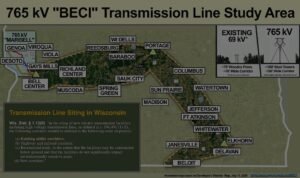
What is unknown. We do not know whether the developers of MariBell or BECI, the two proposed 765,000-volt lines in southern Wisconsin, use this report. The recording, the slides and the report never name either project.
A national webinar walked through the report on August 12
Climate XChange, a national climate-policy nonprofit, hosted Equitable Energy: Engaging Communities in Grid Investment Projects on August 12, 2026.3, p. 21 Rogers spoke for the Great Plains Institute (GPI), a Minneapolis nonprofit. Maury Galbraith spoke for the Colorado Electric Transmission Authority (CETA), which he runs.
The host introduced Rogers at 5:33 as someone who had worked “to discuss the best way to limit opposition to transmission.” Rogers described his aim as finding out how to “build support, or at least not create opposition,” so lines can go up quickly and fairly.1, 5:33 and 6:11 His slide titled “Why does local opposition matter?” says fast building needs “a SOCIAL LICENSE to build.” Without one, the slide says, developers face “costly lawsuits and delays,” protest and action by legislatures.3, p. 9
Page 4 of the report says developers can use it to shape “their messaging,” and that landowners can use it “as a standard for the kind of engagement they should expect.”2, p. 4 It draws on 110 interviews along 11 lines in 11 states, seven of them in the region of MISO, the grid operator whose long-range plan includes MariBell and BECI.2, pp. 1 and 9
We searched the recording’s transcript, the 34 slides, the recap and the 63-page report for MariBell, BECI and every company developing them. None appears. The report quotes the developers it interviewed without names, one of them from Wisconsin, so we cannot say who took part.2, p. 56
Four questions sort every objection in the report
Rogers coded 910 answers from his interviews and public comments, then grouped them under four questions.2, pp. 10 and 11 The advice after each question is our summary of the report’s pages 17 to 61.
- Harm: “How will this negatively impact my life?” Its advice: stay out of sensitive land, and pay landowners more than fair market value.
- Need: “Why is this project even needed?” Its advice: explain the benefits in local terms, and study newer grid technology, burial and highway routes as alternatives.
- Consultation: “How will I be consulted on this project?” Its advice: keep coming back for the life of the project, move the route on a farm when the owner asks, and limit eminent domain “to the greatest extent possible.”
- Compensation: “How will I be compensated for any potential harm caused by this project?” Its advice: help towns work out their tax revenue without relying on the developer’s numbers, and give community grants early with no strings attached.
Rogers said need is “much less talked about” in the research and in public talk about outreach, and the report says it “should be a focus.”1, 10:14; 2, p. 12 At 10:25 he told the audience that if a line is not needed, every harm “just got about 10 times worse, because it’s needless harm.”1, 10:25
Developers in the study complained of limits on billing outreach to ratepayers
Rogers argued for outreach that never stops, because a line can take decades and, as his slide puts it, “People forget projects are happening.”1, 14:04; 3, p. 14 Some of the most influential opponents he met had been turned away early, and some of them later ran for county commissioner.1, 14:50 For the developer, the report says, steady outreach “defrays legal and public relations and engineering costs.”2, p. 42
Developers in the study “complained of regulatory caps on how much they could recover from ratepayers for community engagements.” The report grants that the caps have “a good reason,” since “consumers should not be required to pay for unnecessary expenses.” Once a project is approved, it adds, “ratepayers are expected to pay for the consequences of the engagement process, good or bad.” It asks developers and policy makers to “reassess” the caps.2, pp. 45 and 63 Rogers’s slide titled “Early and Often” lists a single policy step: “Cost-recovery for processes we know mitigate opposition.”3, p. 14
Rogers urged project backers to brief farm groups
At 46:17, Rogers said a landowner who belongs to “the Cattlemen’s Association or the Farm Bureau, or part of a Native American tribe” usually goes to that group for information. Anyone “who wants to see the project get built,” he said, should be briefing those groups so they can pass on accurate information.1, 46:17 and 46:34 The report says developers have used “third-party local messengers to advocate for the line,” with “varying degrees of success.”2, p. 26 If a group you belong to hands out material about a line, ask who wrote it and who paid for it.
Micrositing means moving the route on one farm
Rogers defined micrositing as “effectively just listening to landowners” about the least harmful spot on their land. The line “might be a little bit zig-zaggier. It might cost a little bit more,” he said, but the developer saves on legal costs and delays.1, 17:25 and 18:01 He added, “We have not done a quantitative analysis on this.”1, 18:20 The report calls the early results “promising.” It also records developers who promised landowners a route change on their property “but later reneged on that promise after receiving state permits.”2, p. 48
Gifts can look like an attempt to buy support
Rogers called local tax revenue “one of the largest financial incentives” for a transmission line. His slide says knowing the expected amount “motivates support.”1, 19:07; 3, p. 17 The report’s chapter on gifts runs from “buying the prize cow or pig at a county fair and donating it back” to funds that community leaders direct. People who feel a developer is “trying to buy their support,” it warns, “are likely to oppose the project.” It advises giving early and without strings, through a local nonprofit when the sums are large.2, pp. 60 and 61
Rogers compared transmission to insurance
A question read by the host said talk of system-wide savings falls flat with local audiences. Rogers answered with the Southwest Power Pool, which put off a 765 kV backbone around 2010 at about $7 billion to $8 billion. The cost is now “reaching up into the 18 billion range,” he said.1, 52:34 Transmission, he went on, is “like insurance,” the way car insurance keeps a crash from coming out of your own pocket.1, 53:35 The host, Climate XChange’s Kristen Soares, then offered a way to talk about bills. “Your bill is going to go up like this, and now it’s going to go up like this. It’s still going up, but we have to invest.”1, 56:56
Galbraith said the benefit numbers a community hears usually come from the developer. “There’s a conflict of interest there,” he said.1, 54:21 He and Rogers both said transmission usually pays off. Galbraith put benefit-cost ratios above one “by a significant margin,” and Rogers said the Southwest Power Pool’s look-backs found its early estimates were usually too low.1, 49:40 and 55:49 For the group of MISO projects that includes MariBell and BECI, MISO’s benefit figure and its market monitor’s figure are far apart. Our By the numbers page shows both.7
The developers’ own words, sorted by the report’s four questions
Midcontinent Grid Solutions (MGS) is developing BECI. Dairyland Power Cooperative and GridLiance Heartland are developing MariBell. Nothing we found shows any of them used this report or joined the webinar, and much of their vocabulary is common well beyond these two projects. NMPP Energy, a utility group in Lincoln, Nebraska, called grid operators “the ‘air traffic controllers’ of the U.S. electric grid” in 2023. The PSC’s own review guide speaks of “avoiding or minimizing adverse environmental effects.”16; 5, p. 5
Asked about wildlife on WRCO’s Morning Show on September 22, Radday said, “our goal is, and I say it a lot, is to minimize impact.” We counted the phrase 13 times in a transcript of the 21-minute interview.8, 14:09 MGS’s letter to Richland County eight days earlier used it too: “we work to minimize the impact of this important project for Wisconsin.”9, p. 1 A heading on MariBell’s homepage reads “Leveraging existing locations to minimize impact.”12
When the host asked why the line doesn’t follow the interstate, Radday began with need. “So the need for BECI was determined by MISO,” he said, based on peak load “going up in the central region, including Wisconsin.”8, 3:42 and 4:00 GridLiance Heartland’s Jessica Hewitt also pointed to MISO when she briefed the Houston County, Minnesota, board in November 2025: “They are the ones that determine the project needs.” Board chairman Eric Johnson said, “MISO is who we need to talk with.”13 MISO chose both lines for its long-range plan in December 2024, and in Wisconsin the PSC reviews every transmission application for “need, and cost/benefit.”5, p. 5
Near the end of the interview, Radday said the “main takeaway” from “every interaction” with his team “is that we want to hear from them. We value their feedback.” He used the word “feedback” 16 times.8, 19:41 An MGS open-house board says “Your feedback is valuable.”11, p. 27
Another MGS board says “Property owners should be fairly compensated for any acquired land rights.”11, p. 18 MariBell’s homepage puts Wisconsin’s share at “approximately $35 million* in impact fees.” Its footnote credits Strategic Economic Research, LLC.12 Wisconsin law sets those fees for any line of 345 kV or more that the PSC approves. The owner pays 0.3 percent of the line’s cost each year, plus a one-time 5 percent, through the state to host counties and municipalities.15 We found no tax or fee figure from MGS. Its boards say the line “helps create local jobs, supports area businesses and strengthens the local economy.”11, p. 9
Radday called MISO “like air traffic control for the electric grid,” the same picture MGS’s FAQ uses.8, 3:49; 10 MGS’s August 5 press release quotes a MISO planning executive, the president of the electrical workers’ union and the head of Wisconsin Manufacturers & Commerce.14 In the materials we read, no developer used the insurance comparison or quoted a farm group.
MGS’s Alan Ott told the Daily Union on August 26, “The routes will definitely change based on the feedback we get at this series of open houses.”17 When MGS publishes its preliminary routes, compare them with the segments you commented on.
The speakers faulted commissioner-first deals and cubicle outreach
Rogers described one project he did not name. Its developer “went to the county commissioners first,” made, in his words, “some backroom deals effectively,” and only then brought landowners a finished route.1, 58:09 Many developers “have started to learn from those past mistakes,” he said, though the approach is still “advocated for in some circles in development.”1, 58:51 Galbraith faulted developers who write their outreach “in their cubicles.” He ended the question period by telling them to “prepare for it and be ready for it and have strategies for addressing it,” meaning local opposition.1, 1:00:15 and 1:00:38
Galbraith’s authority writes its outreach rules into partner agreements that “will be legally enforceable,” including a duty to record “local community input and the project sponsor’s responses.” He said CETA will “walk away from a partnership” if a partner breaks them.4, pp. 1 and 3; 1, 41:46 CETA’s rules do not apply in Wisconsin.
What you can do
In Wisconsin, a developer may hold public meetings before it files with the Public Service Commission (PSC), and comments there go to the developer.5, p. 4 After the PSC accepts an application, comments in its first notice period help its staff. They “do not become part of the official record the commissioners review.” Comments filed in the period set by a Notice of Hearing do.5, pp. 4 and 5; 6 A line above 345 kV gets a full environmental impact statement, and the PSC’s final route can be “a route variation suggested by the public.”5, pp. 6 and 8 Our comment deadlines page lists each window as it opens.
Wherever you are asked for input, get these in writing and keep the handouts and maps:
- What was still undecided when you were asked.
- The answer to your question, and what changed because of it.
- Who chose and paid any adviser, facilitator or messenger.
- Where a promise is written down, on a slide, in a signed contract or in a permit condition, and who enforces it.
- Whether your comment reaches the body that decides.
Legal note. This post describes public research, public statements and the PSC’s published review process. General information, not legal advice. Talk to your own attorney before you sign an easement or join a landowner group.