Landowners and neighbors in the Richland Center area will meet Thursday, July 16 at 6 pm at the Phoenix Center in Richland Center (doors at 5 pm) to discuss the proposed BECI 765 kV transmission line — what it could mean for their properties and communities, and what the process ahead looks like. The meeting was announced this week by the Landowners Outreach Team, a volunteer group of area landowners; landowners in the Towns of Richland Center, Buena Vista, and Orion and the City of Richland Center are the primary discussants.
Full meeting details are on the campaign calendar →
Source · Landowners Outreach Team meeting announcement, July 2026
The line in question
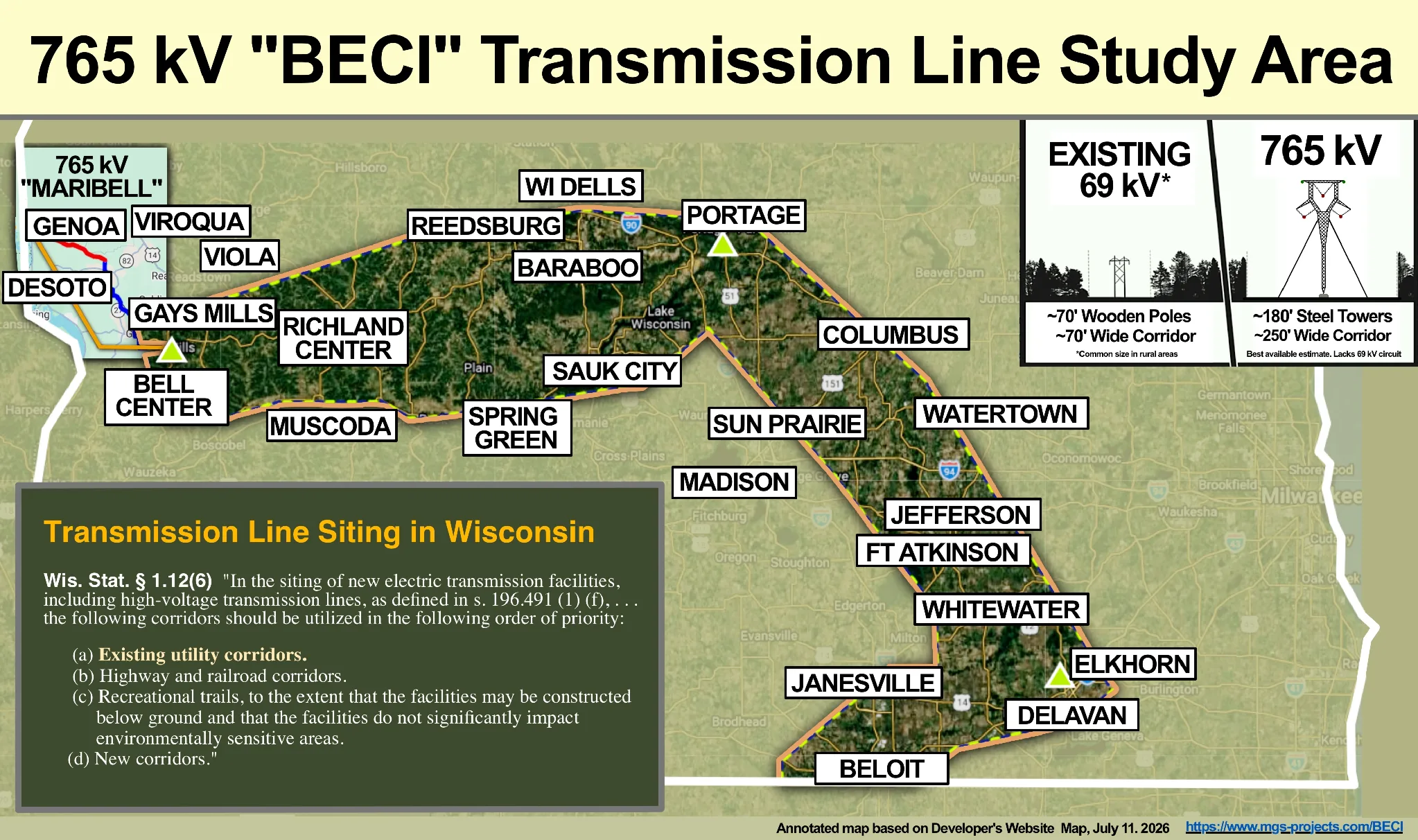
BECI is the eastern Wisconsin segment of the proposed 765 kV transmission project: in the developer’s words, a “190-mile” line (“nearly 200 miles” in its January announcement) running from Bell Center in Crawford County east across the state — through Richland County — to the Illinois line. It would be built by Midcontinent Grid Solutions, a joint venture of Transource Energy (a subsidiary of American Electric Power and Evergy) and BHE Transmission (a Berkshire Hathaway company), selected through MISO’s competitive process. The line would carry steel towers roughly 180 to 200 feet tall — well over twice the height of the ~70-foot wooden-pole lines common in the region today.
Source · AEP news release, Jan. 7, 2026 · MGS project website
A short window for public input
According to the Landowners Outreach Team’s announcement, the developers intend to submit their application to the Public Service Commission of WisconsinThe state board that decides whether power lines get built. The application it reviews — a Certificate of Public Convenience and Necessity, or CPCN — opens the formal window where the public can comment and intervene. as soon as next February — roughly seven months from the project’s public announcement. For comparison, the announcement notes, the developers of Wisconsin’s last two major expansion lines — Badger-Coulee (2013) and Cardinal-Hickory Creek (2016) — spent about three years informing the public and working with landowners and communities before filing.
The team says landowners have been asking the BECI developers for detailed route maps since January, and that Richland County and the Richland Electric Cooperative’s member-owners each adopted information-request resolutions this spring. So far, it says, the requested map materials have not been provided. The developers’ project page invites the public to review maps at future open houses, and says open-house “dates, times, and locations will be posted here when available.”
Source · Landowners Outreach Team meeting announcement, July 2026 · Resolution records on our Resolution tracker
Homes near the existing corridor
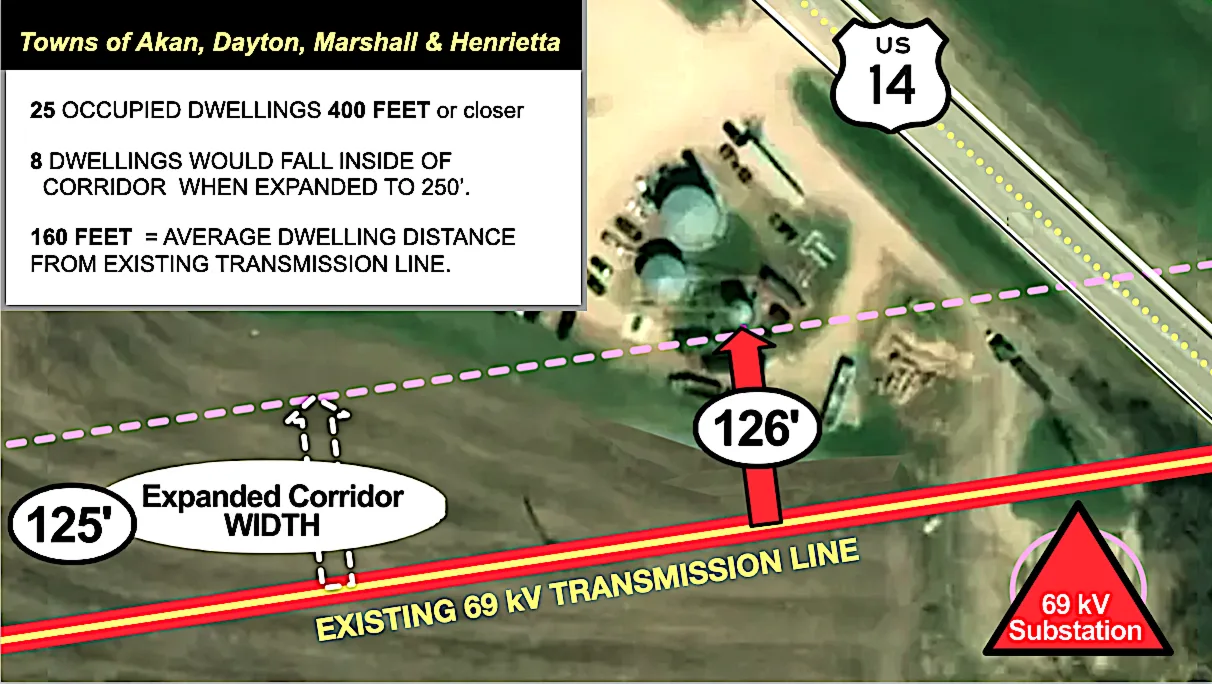
Wisconsin’s transmission-siting statute, Wis. Stat. § 1.12(6), lists existing utility corridors first in the order of priority for routing new lines. That makes the ground along today’s lines the place to look first — and it is where people live. At a landowner discussion in Boaz this May, the team reports, participants identified 25 occupied dwellings within 400 feet of the centerline of an existing, routing-eligible transmission line in the Towns of Akan, Dayton, Marshall, and Henrietta — an average of just 160 feet from the line, with eight dwellings inside the area a corridor widened to 250 feet would cover.
Thursday’s discussion turns to the Richland Center area, where the announcement notes the existing corridor passes through more densely populated and commercial parcels, including many along State Highway 14.
Source · Landowners Outreach Team meeting announcement, July 2026 (participant field measurements, Boaz landowner discussion, May 2026)
Search your address to see how close the proposed corridor and study area come to your land — then, if you’ve been contacted or want support, request landowner support. It’s free, confidential, and describes your options in plain language.
The meeting announcement was issued by Rob Danielson, a potentially affected landowner and a member of the Landowners Outreach Team. The meeting is organized by landowners, for landowners; No 765 Line volunteers will help with sign-in at the door. For more information about the meeting, see the event listing or email info@no765line.org.
A public MISO plan — built by private companies, paid by ratepayers.
The proposed line is part of MISO’s regional transmission plan (Tranche 2.1) — not a private or “merchant” venture. The BECI segment was awarded through MISO’s competitive process to Midcontinent Grid Solutions, a joint venture of Transource Energy (AEP/Evergy) and Berkshire Hathaway’s BHE Transmission — private, for-profit companies earning a regulated return on a build whose costs would be allocated to Wisconsin ratepayers and others across the region.
Source · MISO Long-Range Transmission Plan (Tranche 2.1) · AEP news release, Jan. 7, 2026