Media contact: Rob Danielson, No 765 Line, Inc. — info@no765line.org
Reproduce freely. This release and the maps below may be republished with credit to No 765 Line, Inc.
Public Information Phase launched by out-of-state 765 kV transmission developer fails to notify ~134,000 potentially affected landowners.
RICHLAND CENTER, WISCONSIN, JULY 24, 2026 – In the past, when large expansion transmission lines were announced in Wisconsin, potentially impacted land owners could expect two things: being mailed a personalized map showing where and how the proposed transmission line might affect their property and knowledge that there would be several years to resolve potential hazardous siting conditions such as occupied dwellings being unacceptably close to the enlarged transmission facility. Not so in Wisconsin, today.
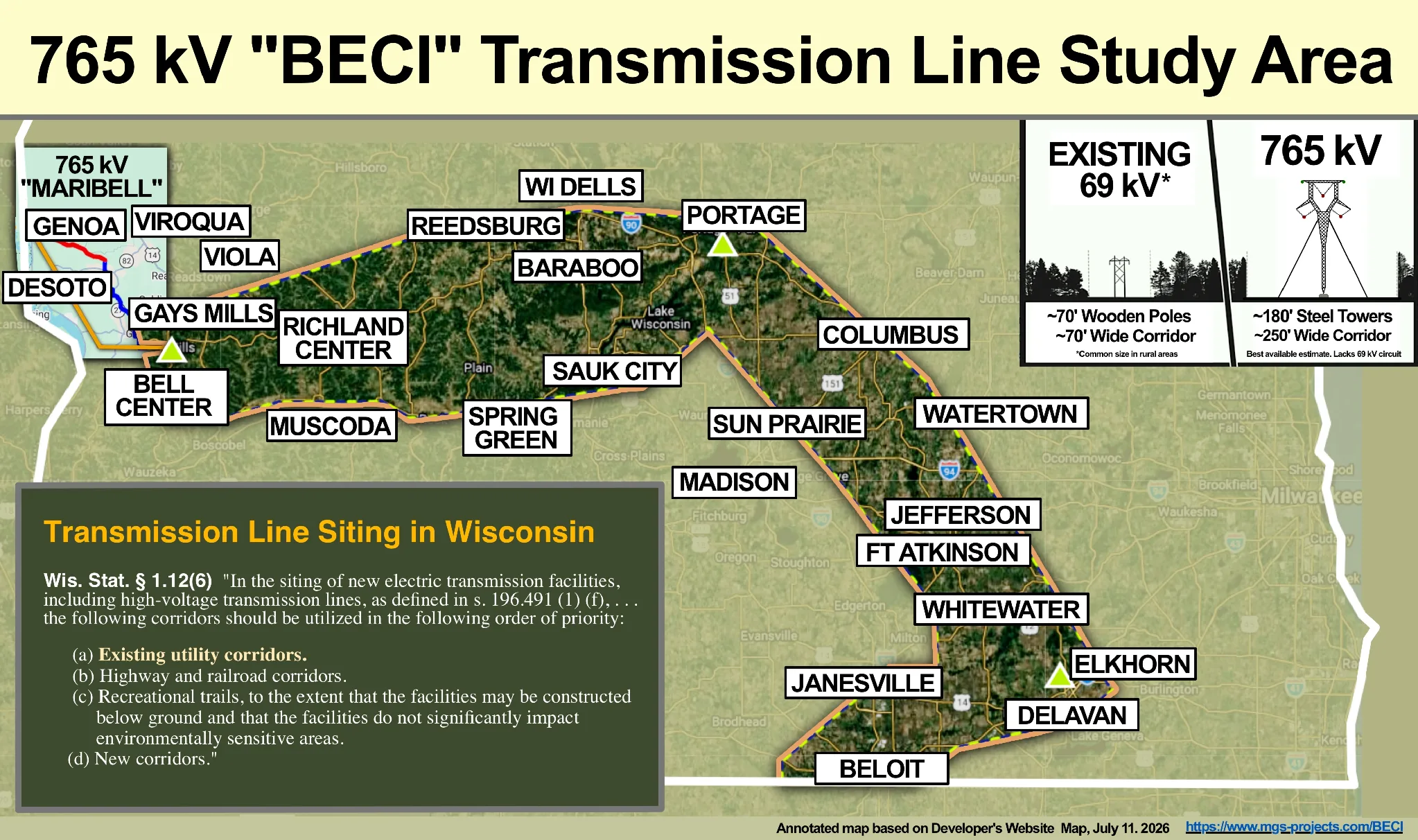
The website launched on July 9 announcing Midcontinent Grid Solutions (MGS) intent to propose and build a 190-mile long transmission line through Crawford, Vernon, Richland, Sauk, Columbia, Dane, Jefferson, Walworth and Rock Counties — a reach based on the developer’s early-stage study-area map and the existing transmission corridors state law directs developers to examine first — fails to provide mapping of any preliminary routes – leaving ~134,000 potentially affected landowners unaware of its potential impact on their properties and, in many cases, their livelihoods.
On the same day, representatives of MGS informed officials in Richland County that the out-of-state, limited liability corporation that has never proposed a transmission line in Wisconsin, to date has allotted only seven months for all landowner, community and local government notification and interactions before submitting their application to the Public Service Commission of WisconsinThe state board that decides whether power lines get built. The application it reviews — a Certificate of Public Convenience and Necessity, or CPCN — opens the formal window where the public can comment and intervene. (PSC) in February, 2027.
In striking contrast, the public information and siting adjustment stages for the Badger-Coulee 345-kV transmission line were conducted over 37 months. The developers’ initial announcement began with thousands of personalized mailings to potentially impacted land owners including local maps of the existing transmission line corridors under evaluation and an invitation to the first of four rounds of Open Houses over two years. A third year was set aside for landowners to meet with transmission line siting engineers to address hazardous and undesirable siting conditions.
Rob Danielson, a Vernon County landowner who opposed the 2010-2015 Badger-Coulee proposal, has concerns about the planning process and the impact of the BECI line. “It is unclear how familiar the out-of-state transmission line developers are with Wisconsin laws guiding transmission proposals,” he said. Wisconsin statute 1.12(6) requires developers to first examine existing transmission line corridors when proposing a new transmission line.
Source · Wis. Stat. § 1.12(6) · MGS project website
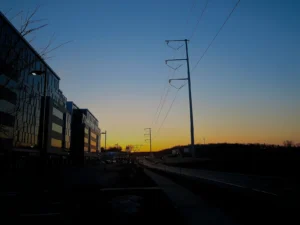
Persons who have spent some time in the wooded hills and valleys of the Driftless Area have probably observed the existing, ~75-year-old, wooden pole transmission lines passing very close to occupied homes, dairy operations, farms, B&B’s and sensitive environmental assets such as trout streams, family farms, and protected natural areas.
At a recent meeting of potentially impacted landowners in the Towns of Richland Center, Orion and Buena Vista in Richland County, it was estimated that more than 80 occupied dwellings in those communities would be placed in jeopardy if the existing ~70-foot wide easements were to be expanded to 250 feet. “The number of at-risk dwellings is considerable, due to the existing transmission corridor passing through more densely populated and commercialized areas, including many parcels along State Highway 14. Such concerning land use predicaments for landowners and communities stand to be duplicated many fold across the nine-county, 190-mile span of the proposed BECI line,” said Danielson.
The facility, with 180- to 200-foot high steel towers and easement widths of approximately 250 feet, is part of MISO’s $22 billion Tranche 2.1 transmission expansion package — publicly planned, paid for by ratepayers, and built by private, for-profit developers who earn a regulated return on the cost of construction. The power it would carry is whatever is on the regional grid: a mix that averaged 17% renewable generation in 2024. The Tranche 2.1 expansion package has been roundly criticized by MISO’s own Independent Market Monitor, Dr. David Patton of Potomac Economics, for having unrealistic planning assumptions and great likelihood of unnecessarily and unfairly driving-up costs for electric customers.
Adding to the concerns of potentially affected landowners, a transmission line of this scale and capacity has never before been proposed in Wisconsin or other upper-Midwest states. Further, the novel, guy-wired “Y” design towers that developers are proposing to install across the environmentally sensitive Driftless region, have never been installed and used before.
Correction, September 13, 2026: the sentence above saying the guyed-Y towers “have never been installed and used before” carried no source and is not established. MISO’s BECI selection report of January 6, 2026 describes Transource’s guyed-Y as “a new triangle design” and notes that the developer’s team maintains “over 600 miles of 765 kV” line (report PDF p. 40); guyed 765 kV towers of the older V design are in service in Indiana. Whether a guyed-Y 765 kV line is in service anywhere is unverified either way. The release is kept as issued; this note corrects the record.
“Open and transparent communication” — with no specifics
So far, the developers’ website commits only to an unstated number of “open houses” in unstated locations over the 190-mile BECI span. Developers have not presented landowners, communities and elected officials with maps of preliminary routing which traditionally accompanies the very first public announcement of a proposed expansion transmission project to launch three years of pre-application processes.
The paragraph description of “Community Engagement” on the MGS website references “multiple opportunities” and informational “open houses” with no specifics. Landowners are promised the ability to provide “input” on proposed route options before a final route is selected but with no indication of how landowner input will be utilized – such as meetings between landowners and transmission line siting engineers to resolve hazards and other undesirable conditions. The developer’s claim that it is committed to “open and transparent communication” has no basis at this point.
So what are the developers effectively proposing to accomplish over the next few months? They need to provide hundreds of potentially impacted landowners with to-scale, parcel by parcel, highly-detailed, satellite-based maps of the route(s) they are proposing. To achieve timely siting adjustments, the developers need to schedule and conclude hundreds of one-on-one meetings with landowners and transmission siting engineers before the end of 2026.
Understanding the proposal’s unprecedented scale, alert Richland County landowners have been asking BECI developers for detailed maps and other important siting information since January. Richland County and Richland Electric Cooperative Member Owners unanimously adopted Information Request Resolutions last Spring, asking for similar detailed routing information. None have reported receipt of the requested materials.
Source · MGS project website, “Community Engagement” · Resolution records on our Resolution tracker
“I only found out about the threat to my property from people in Crawford and Vernon Counties who’ve been trying for months to get information from another developer regarding the segment of the line that’s proposed to go through their area. Many of them were quietly approached and offered small sums of money to survey their land,” said Janet Johnson, a horse breeder in Richland County, “I wonder how people east of me will learn about this before it’s too late for them to do anything about it.”
For the potential westward-lying MariBell segment of the same 765 kV transmission facility, directly-impacted landowners in Vernon and Crawford Counties began requesting detailed maps and one-on-one meetings with transmission siting engineers nine months ago. Similarly, these requests remain unfulfilled. MariBell would be a joint proposal of Dairyland Power Cooperative and a subsidiary of Florida Power and Light, the largest regulated electric utility in the United States.
On their newly released website, BECI developers invite landowners, elected officials, local governments and community members to email: Connect@MGSWisconsin.com
# # #
About the organizations named in this release
Midcontinent Grid Solutions. Midcontinent Grid Solutions (MGS) was selected by MISO to build and maintain the BECI line. MGS pulls together the expertise and experience of Transource Energy — a joint venture of American Electric Power and Evergy — and Berkshire Hathaway Energy U.S. Transmission. mgs-projects.com/BECI
Midcontinent Independent System Operator. Midcontinent Independent System Operator (MISO) is the nonprofit that runs the electric grid and plans large power lines across 15 states, including Wisconsin. It plans which lines get built; state regulators must still approve them.
No 765 Line. No 765 Line is a nonprofit organization comprised of citizens, businesses, and organizations that share concerns about the potential impact of the soon-to-be proposed 765 kV transmission line being planned to cross southern Wisconsin and beyond. no765line.org
Media assets
The maps below are free to reproduce with credit to No 765 Line, Inc. Reporters who need a different crop, a higher resolution, or an interview should email info@no765line.org.
This release as a PDF — 698 KB, letterhead, print-ready
BECI study area, annotated — 2046 × 1212
All press releases · Press & media kit
Sources & notes
Added by No 765 Line. These notes are not part of the release as issued to media on July 24, 2026. This web version incorporates the author’s corrections of July 26, 2026: a study-area disclaimer on the county list, the corrected description of Dr. Patton’s role, and a revised description of the Tranche 2.1 package. The media contact for the hosted version is the organization’s address, info@no765line.org.
- Wisconsin’s corridor-priority statute. Wis. Stat. § 1.12(6) lists existing utility corridors first in the order of priority for siting new transmission, ahead of highway and railroad corridors, recreational trails, and new corridors.
- Who MGS is. Midcontinent Grid Solutions is a joint venture of Transource Energy (American Electric Power and Evergy) and BHE Transmission (Berkshire Hathaway), selected through MISO’s competitive process — AEP news release, Jan. 7, 2026.
- The study area. The developer has published a study area, not a route. Our reading of its published polygon puts it at about 2,800 square miles across nine counties — Crawford, Richland, Sauk, Columbia, Dodge, Dane, Jefferson, Rock and Walworth — with no route miles filed. The release’s county list differs in two places: it includes Vernon County, where existing transmission corridors — first in the state’s siting order of priority under Wis. Stat. § 1.12(6) — remain available routes the developer has not formally ruled out, and it omits Dodge County, which the published polygon reaches but existing corridor paths make less likely. Until the developer publishes a route, no county is confirmed in or out. See the corridor map and By the numbers.
- The ~134,000 landowners figure is the campaign’s estimate, compiled from public land-ownership records for the counties named in the release. The developer has published no preliminary routes and no count of potentially affected landowners.
- Dr. David Patton is the Independent Market Monitor for MISO (Potomac Economics). His critique of the Tranche 2.1 benefit-cost case appears in filings at FERC; see The road to the CPCN for how the regional plan reaches the Wisconsin PSC.
- The 17% renewable figure. In 2024, renewable generation across Midwest market outlets averaged about 17% — 2024 MISO State of the Market Report (Potomac Economics), Table 1. The same figure and its growth-rate context appear in our earlier analysis, Opting out of unneeded utility expansion.
- The ~250-foot corridor. The campaign’s best available estimate of the width a 765 kV corridor would require, shown in the study-area graphic above alongside the ~70-foot corridors common in the region today. As that graphic notes, the estimate covers the 765 kV facility alone and does not include the existing 69 kV circuit, so a co-located corridor could be wider. No easement width has been filed by the developer.
- The guyed-Y towers. MISO, BECI Competitive Transmission Project Selection Report, January 6, 2026, PDF pp. 6, 17 and 40 (structure design, right-of-way, operations and maintenance). Cited by the September 13, 2026 correction.
The campaign’s full sourcing for figures on this site is collected in the document library and By the numbers.