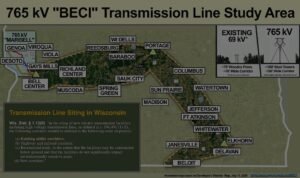
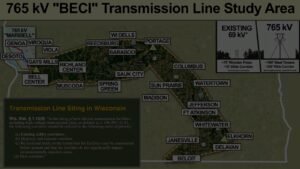
Two things happened this month that are worth holding side by side. In Washington, federal regulators granted the companies behind the BECI 765 kV line — the eastern continuation of the corridor proposed through Southwest Wisconsin — a set of cost-recovery incentives, including one that lets them bill ratepayers for the project’s costs even if the line is never built. And on the radio in Richland Center, a Crawford County landowner spent most of an hour explaining, in plain language, what this project would mean for the people who live in its path.
One of those tells you how the money works. The other tells you who carries the consequences. Together they make the question this campaign keeps asking harder to ignore: who profits, and who pays?
What the developers asked for — and got
BECI — the Bell Center–Columbia–Sugar Creek–IL/WI State Line project — is being developed by Midcontinent Grid Solutions, a 50/50 joint venture of Transource Energy (owned by utility giants AEP and Evergy) and BHE Transmission (Berkshire Hathaway Energy). On April 29, the venture’s Wisconsin company asked the Federal Energy Regulatory CommissionFERC — the federal agency that sets the rules for how transmission owners charge ratepayers. It doesn’t decide whether the line gets built (that’s the Wisconsin PSC); it decides how the developers get paid. to approve how it will charge for the project, including an abandoned-plant incentiveA federal rate incentive that lets a transmission developer recover 100% of its prudently incurred project costs from ratepayers if the project is cancelled for reasons beyond the developer’s control — for example, if it fails to win a state permit. — the provision that entitles a developer to recover 100 percent of its prudently incurred costs from ratepayers if the project is later cancelled for reasons beyond its control.
On June 26, 2026, FERC granted it — the abandoned-plant incentive and the rest of the requested package: a formula rate copied from the venture’s Iowa affiliate, a hypothetical capital structurePermission to set rates as if the company were financed with 60% equity and 40% debt — a costlier mix for ratepayers than heavy debt financing — regardless of how it is actually financed, until real long-term debt is in place or the project is in service. of 60% equity and 40% debt, a regulatory-asset account that banks the venture’s pre-commercial and formation costs for later recovery, and a conditional bonus on its return on equity for joining MISO. All of it took effect June 29.
Read plainly: if BECI is abandoned someday — including because a permit never comes — the developers can seek to be made whole by the public for every prudently spent dollar from June 29 forward. The risk of this multi-billion-dollar bet does not sit with the companies making it. And one more detail worth knowing: when FERC put the request out for public comment in May, not a single protest or intervention was filed. The money rules for a ~188-mile line across eight Wisconsin counties — the developers’ own count, in this filing — were set without one objection on the record, months before most people in those counties had heard the project’s name.
The developers were candid with FERC about why they wanted the protection. Their filing describes extensive permitting, siting, and construction risks — including that “there is no guarantee that permits will be granted, remain unchallenged, or be issued without conditions that could delay or require abandonment” of parts of the project, and that they still need a Certificate of Public Convenience and Necessity from the Wisconsin PSC. That is not our characterization — it is their own assessment of this project’s uncertainty, made in a federal filing.
To be precise about what this is and isn’t: these incentives are standard tools FERC offers transmission developers, the filing followed the normal process, and none of it decides whether the line gets built. That decision still belongs to state regulators. What the order settles is the direction the financial risk flows — and it flows toward ratepayers, before a single route has been proposed.
Source · FERC, Midcontinent Grid Solutions Wisconsin, LLC, 195 FERC ¶ 61,251, Docket No. ER26-2376-000 (issued June 26, 2026); Federal Register, Combined Notice of Filings, May 5, 2026; Transource/BHE announcement, January 2026
Even FERC’s chairman has questions
The order came with two unusual notes attached. FERC Chairman Laura V. Swett and Commissioner David Rosner voted yes — and then filed a joint concurrence saying “the time has likely come for the Commission to reconsider its approach to granting hypothetical capital structure incentives on a going-forward basis.” Their reasoning speaks directly to places like the Driftless: “It is increasingly obvious,” they wrote, “that a key barrier to energy infrastructure buildout in this country is fostering public trust that particular projects are needed.” Project sponsors, they added, “can and should do more to explain how their projects, and their requests for a hypothetical capital structure, will provide reliable power and save consumers money.”
Commissioner Judy W. Chang went further and dissented in part. She would have refused the 60/40 structure outright and sent it to a hearing, writing that the developers “did not provide any company-specific analysis to support” the request and “did not demonstrate that comparable transmission companies are capitalized by 60% equity and 40% debt.”
Hold those two statements together: the developers got their incentives, and the regulators who granted them said — in the same order — that public trust in whether projects are needed is the problem, and that sponsors should do more to show their projects save consumers money. When the people signing the approvals talk like that, it is fair for the people who would pay to ask the same questions — on the record, in every forum this project passes through.
Source · Swett & Rosner, joint concurrence, and Chang, dissent in part, Midcontinent Grid Solutions Wisconsin, LLC, 195 FERC ¶ 61,251 (June 26, 2026) — quotations verbatim from the statements
the developers’ announced investment in BECI — earning a regulated return, paid through electric rates.
Source · Transource/BHE announcement, Jan. 2026across eight Wisconsin counties, by the developers’ own count — with no route selected yet.
Source · 195 FERC ¶ 61,251 at P 9; MISO BECI Selection Report, Jan. 6, 2026of prudently incurred costs the developers may recover from ratepayers if the project is abandoned for reasons beyond their control.
Source · 195 FERC ¶ 61,251 at PP 24–26 (June 26, 2026)An hour of plain talk on WRCO
On July 7, Rob Danielson — a potentially affected Crawford County landowner and a member of the Landowners Outreach Team — joined the Morning Show on WRCO in Richland Center for a nearly hour-long conversation about the BECI proposal — what it is, how it connects to the MariBell line at Bell Center, what MISO’s planning process does and doesn’t decide, and what residents of Vernon, Crawford, Richland, Sauk, and Columbia counties can expect as the project moves toward a state filing. If you want one listen that catches a neighbor up on this project, this is it.
Listen to the segment at Civic Media → (a transcript is available on the episode page). Share it with a neighbor along the corridor — especially someone who hasn’t heard of BECI yet, because most people east of Bell Center haven’t.
Source · WRCO Morning Show via Civic Media, July 7, 2026
A public MISO plan, built by companies that profit.
The line is part of MISOThe Midcontinent Independent System Operator — the nonprofit that runs the electric grid and plans large power lines across 15 states, including Wisconsin. It plans which lines get built; state regulators still have to approve them.‘s regional transmission plan (Tranche 2.1) — a publicly planned, cost-allocated project, not a private or “merchant” venture. What we question is who benefits: of the companies developing the two lines, only Dairyland Power Cooperative is member-owned. The rest are private firms earning a regulated return, and Wisconsin ratepayers would help pay.
Source · MISO Long-Range Transmission Plan (Tranche 2.1) cost allocationWhere this goes next
BECI still has no announced or filed route — only five named connection points, which you can now see on our interactive corridor map: Bell Center, the Hillsboro area, the Columbia substation near Portage, the Sugar Creek substation near Elkhorn, and a state-line crossing in Rock County still to be sited. The developers’ state permit application is expected in early 2027, and that CPCNA Certificate of Public Convenience and Necessity — the construction permit the developers must win from the Wisconsin PSC before they can build. The CPCN case is where the public can formally weigh in. case before the Wisconsin PSC is where the public gets its formal say.
There is also a federal window open right now: the U.S. Department of Energy is taking public comments on its draft 2026 National Transmission Needs Study — the federal assessment developers will cite as evidence lines like this are needed — until September 7, 2026, by email to NeedsStudy.Comments@hq.doe.gov. We’ll send our email list a plain-language guide to commenting; join the list to get it.
Source · U.S. DOE, Draft 2026 National Transmission Needs Study (comment period closes Sept. 7, 2026)