On August 25, the Viroqua Common Council voted 9 to 0 to adopt Resolution 26RS007, formally stating the city’s opposition to the proposed MariBell 765 kV transmission line.1 Viroqua is the first city in Wisconsin to take that position on the public record.2
Here is the part worth thinking about: The MariBell route does not enter Viroqua. The developers’ own maps run the line across the rural towns of Vernon County and leave the city limits alone.3 The council opposed it anyway, and the resolution explains why in the city’s own words: the towns in the path are Viroqua’s neighbors, the water that rises on Viroqua’s ridge flows down to them, and the farm economy the city depends on lives out there. That is what a good neighbor does in a county seat. You do not wait for the towers to reach your own street.
Michael Browne, who presented to the council alongside Tim Woodhouse of the Coalition Against MariBell 765, is No 765 Line’s treasurer and media lead and is married to Viroqua Mayor Krista Browne. The mayor presides over council meetings and did not cast a vote; the 9 to 0 tally is the council members’.
Why a city the route skips
The resolution stands on three facts about Viroqua, each written into a clause the council adopted.1
- It is the county seat. Viroqua is Vernon County’s center of commerce, health care, education, and government, “so that the residents, farms, and businesses of the towns in the path of the proposed line are the City’s customers, patients, students, employees, and neighbors, and lasting harm to the surrounding towns is lasting harm to the City itself.”
- It sits at the top of the water. The city “sits on the ridge at the top of its watersheds, where waters rise and flow west through the Bad Axe River system to the Mississippi River and east into the Kickapoo River valley.” Everything downstream inherits what happens on the ridge and in the valleys the line would cross.
- It is the hub of an organic farm economy. Vernon County has 230 farms with certified organic production, the most of any Wisconsin county and more than twice the next one, and “Viroqua’s role as a regional local-food and farm-trade center depends on the working lands, pastures, and rural character of the surrounding towns.”4
The council also put itself on the record beside its neighbors. The resolution “stands with the Vernon County Board of Supervisors and the town and village boards of the region that have formally registered their opposition to and concerns about the proposed project,” and asks the Public Service Commission of Wisconsin to “give careful and deliberate consideration to the unique environmental, geologic, hydrologic, economic, and cultural characteristics of the Driftless Area” when it reviews the MariBell application.1
By its own terms, the resolution goes out from the city clerk to the PSC, to Dairyland Power Cooperative and GridLiance Heartland, to the Vernon County Board and every town and village clerk in the county, to the Wisconsin DNR, and to Sen. Brad Pfaff and Rep. Tara Johnson.1
How it happened
The council took the resolution up as Item 19, after a presentation by Michael Browne of No 765 Line and Tim Woodhouse of Genoa, who leads the Coalition Against MariBell 765, the landowner group that has taken the project to court.5 The presentation opened with the number in our name: “These are the biggest power lines ever proposed in Wisconsin,” Browne told the council, then walked through the towers, the twenty-year decline in Wisconsin’s electricity use, the forecast that suddenly reversed it, and what a permanent easement means on an organic farm.6
Council members asked the practical questions: how far apart the towers would stand, how eminent domain would apply to private land, and whether ratepayers would see anything back for the construction. On eminent domain, Woodhouse put it plainly: “The town of Genoa and Vernon County have sat through the presentations and have not seen any benefit to local residents.”6
Alderperson Cyndy Hubbard moved to adopt. The vote was unanimous.6
What the council saw
Below is the deck as it was presented on August 25: fifteen slides in four parts, the machine, the money, the stakes, the fight. Every statistic carries its source on the slide. Swipe or use the arrows, or download the deck as a PDF to share with your own council.7

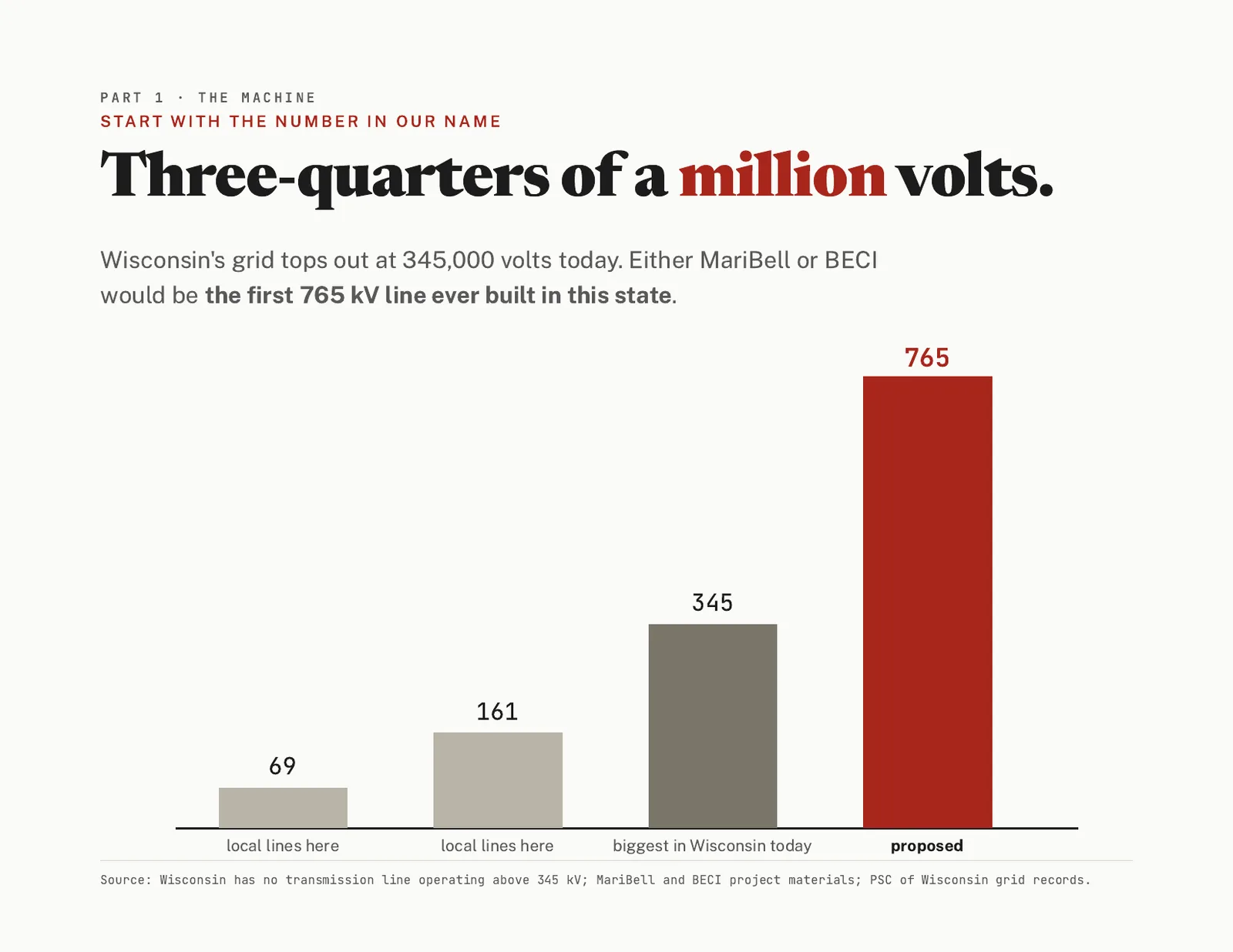
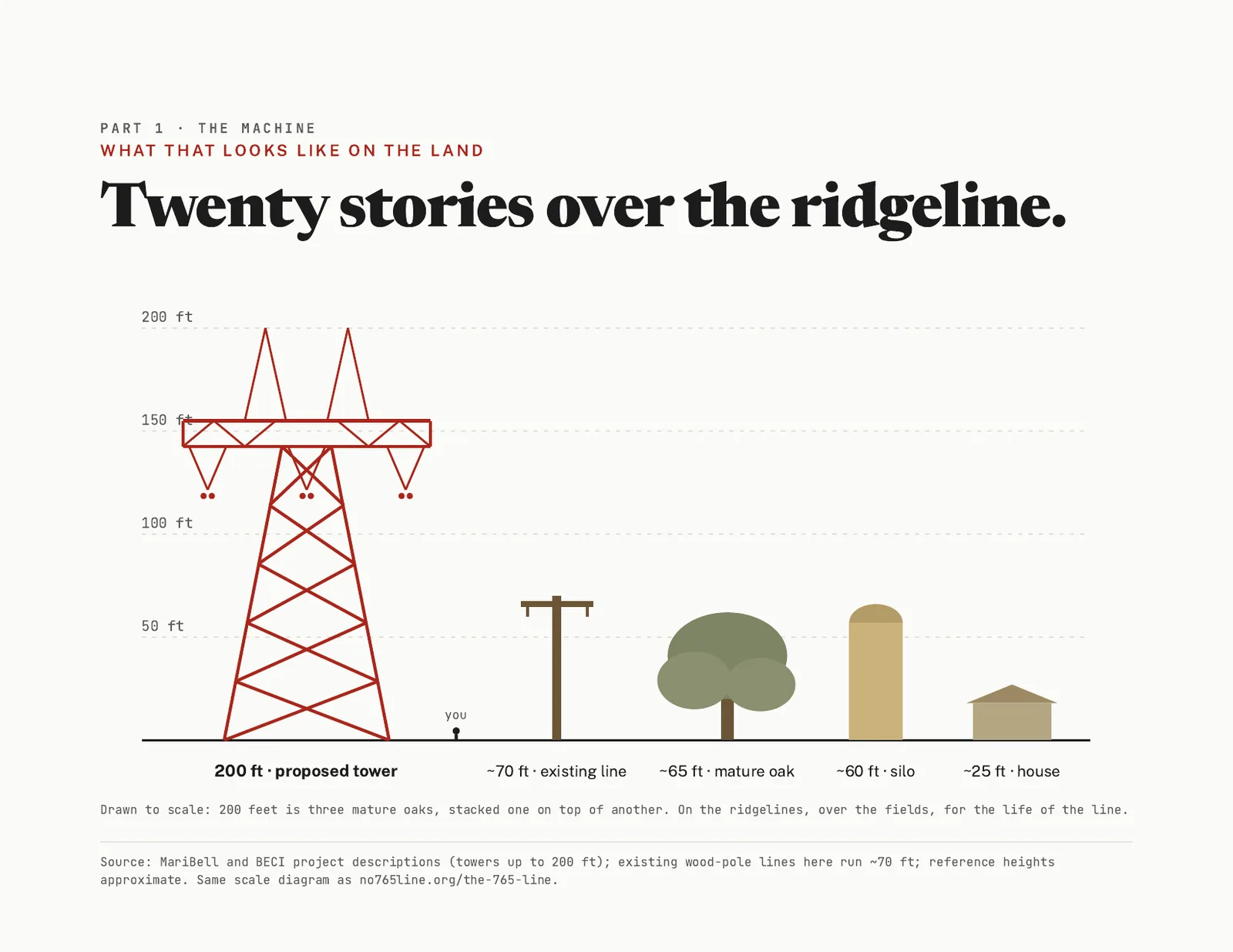

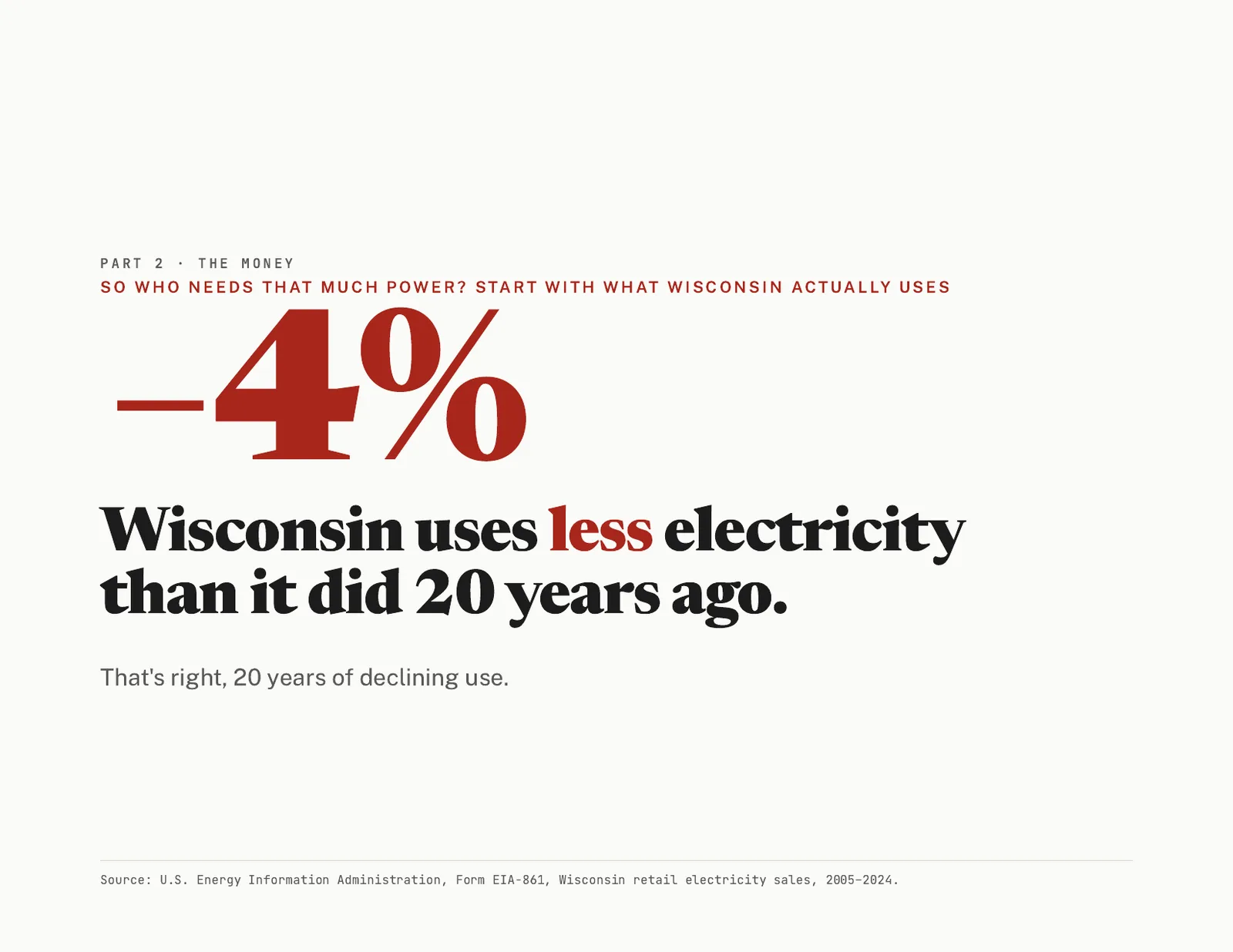


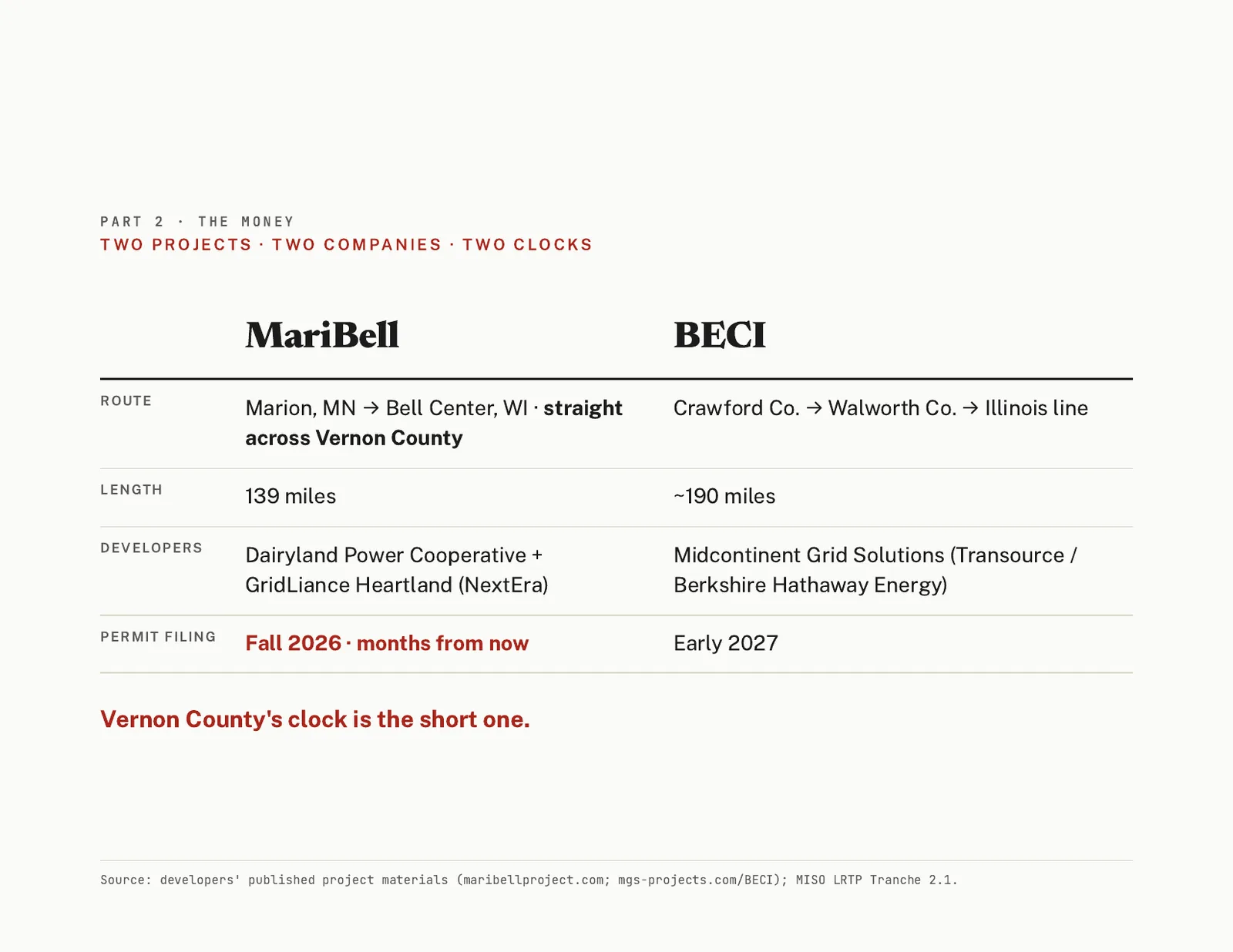
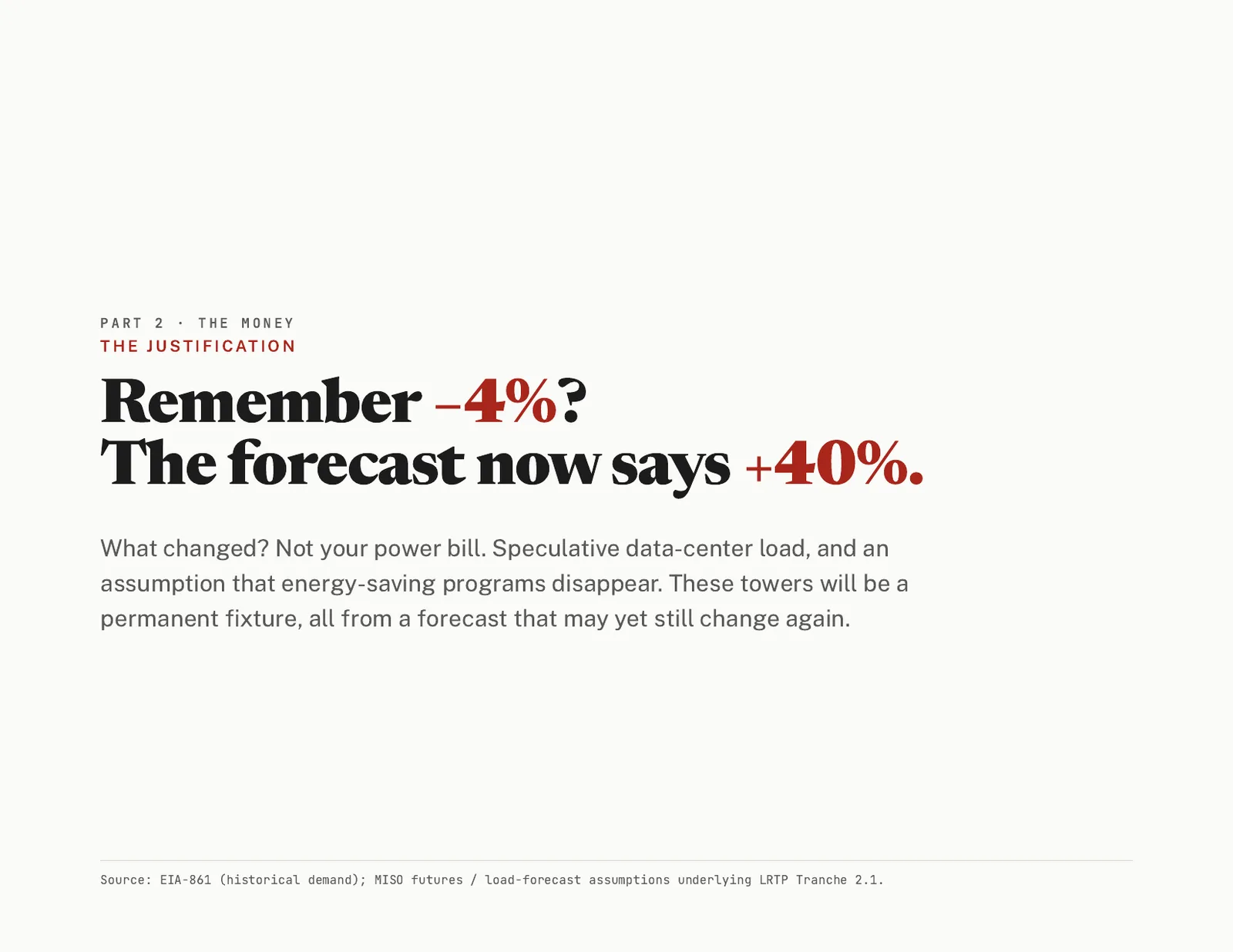




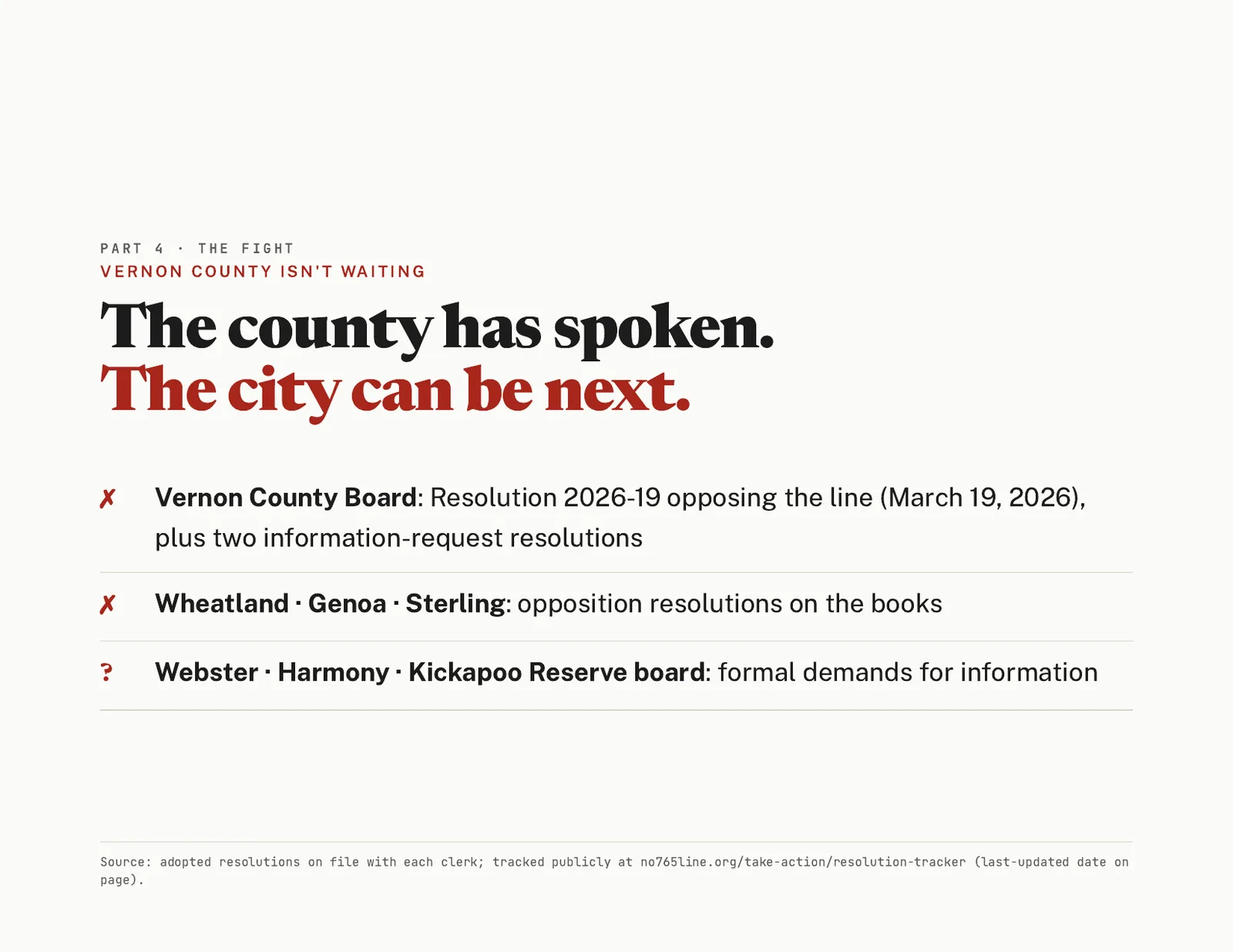

As presented to the Viroqua Common Council, August 25, 2026. The resolution, business, and yard-sign counts on slide 13 are as of that date; the Resolution Tracker is current. Deck: No 765 Line. Sources appear on each slide.
Your city can be next
Twenty-three resolutions and formal actions from twenty units of government are now on Wisconsin’s public record against the two proposed 765 kV lines: four counties, thirteen towns, a village, a reserve board, and, as of August 25, one city.2 Every one of them started with somebody asking.
If you would like your city, village, or town to join them, we have made it as easy as we can. Our page for local officials carries two editable model resolutions, free to any board:
- Opposition resolution (MariBell or BECI), for a board ready to take a position. Viroqua’s resolution shows how far a board can localize it: the county-seat, watershed, and organic-farm clauses above are specific to Viroqua. Read the PDF · Editable Word file
- Information-request resolution (BECI), for a board still deliberating. It takes no position on the project; it asks the developer for specific, verifiable documentation. Read the PDF · Editable Word file
Want a walkthrough for your board, or a presenter at your next meeting? Write to info@no765line.org. And if your board has already acted and is not yet on our Resolution Tracker, send us the signed copy: we list adopted actions only, with the public record attached.
What a resolution does. A municipal resolution states a government’s position and enters it into the public record; it does not by itself approve or block a transmission line. In Wisconsin that decision belongs to the Public Service Commission in the permit proceeding, which for MariBell is expected to begin in fall 2026. This article is general information, not legal advice.